Is the way to a sea star’s heart through it’s stomach?
This week I read a technical journal article published by Dr. Esther Odekunle. Her research focuses on vasopressin (VP) and oxytocin (OT)-sometimes called the love hormone. Both of these are peptide molecules involved in social behavior and physiological functions like diuresis and reproduction. Neuropeptides are small proteins released in the nervous system for communication between neurons. These “fear and love” hormones have become targets for research in treatment of mental disorders such as autism, social anxiety, borderline personality disorder and schizophrenia. Most research on the role of VP/OT-type neuropeptides have been conducted on protostomes (invertebrates) rather than deuterostomes (chordates and echinoderms). Dr. Esther Odekunle’s research was conducted using the sea star Asterias rubens (European common starfish), a deuterostome more closely related to vertebrates than protostomes.
Sea Star Anatomy
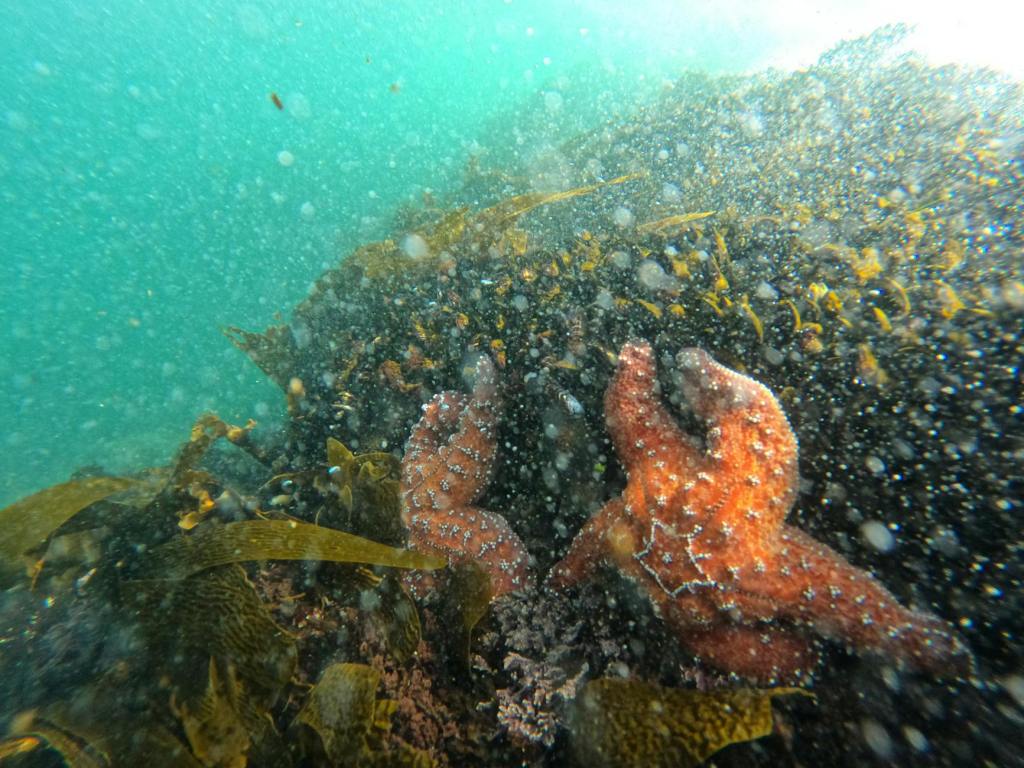
Sea stars lack a centralized brain, however, they have a complex nervous system that consists of a circumoral (“around the mouth”) nerve ring connecting five or more radial nerve cords. The ring, contrary to what you might expect, does not do any processing of information rather maintains information flow from radial nerves. The circumoral nerve has two regions. The hyponeural region contains the motoneurons and the ectoneural region is thought to largely comprise sensory neurons and interneurons. Along each arm, flanking the radial nerve cord are rows of tube feet for locomotion. In the arms there are paired digestive and reproductive organs (ovaries and testes).
Fun Fact! Sea stars have eyes or rather “eyespots” on the tip of each arm. That means a 40-armed sun star has 40 eyes!
About This Study
The gene that encodes for VP/OT-type neuropdptide is called echinotocin. Echinotocin acts as a muscle contractant in sea urchins, which is consistent with the actions of VP and OT in mammals. In this study the researchers preformed extensive experimental analyses of VP/OT-type signaling in Asterias rubens. This involved injecting an oxytocin type hormone called asterotocin in sea stars.
Here is a link to a video illustrating the control group, injected with water and the experimental group, injected with asterotocin.
Results
The results of this study were unusual. The VP/OT-type neuropeptide asterotocin acted as a muscle relaxant in sea stars. Whereas in other taxa, VP/OT-type neuropeptides normally cause muscle contraction. This means that asterotocin is a potent relaxant of the cardiac stomach of sea stars. Relaxation of the cardiac stomach happens naturally when a sea star everts their stomach out of their mouth to feed on prey. This trigger occurred in vitro and in vivo. When a sea star feeds it adopts a humped posture. Asterotocin revealed it also induced a humped feeding postural change. This effect was so powerful that researchers observed sea stars taking 2-3 times longer to right themselves when flipped over. This is an important defense behavior in nature because they can be upturned by strong waves.
To summarize, the same hormone that is released when we hug someone can act to trigger starfish to evert their stomach and take on a feeding posture. OT plays an important role in sea star feeding. Understanding this may help researchers who are studying how to control the Crown-Of-Thorns sea star feeding behavior. This research could lead to potentially developing novel chemical methods to control this species devastating feeding effects. If you do not know of the severity of the threat Crown-Of-Thorns sea stars have to coral reefs, then check out last week’s blog post. I suppose this research may also provide some evidence that the way to a man’s heart is through his stomach. 😉
References
‘Ancient role of vasopressin/oxytocin-type neuropeptides as regulators of feeding revealed in an echinoderm’. Esther A. Odekunle, Dean C. Semmens, Nataly Martynyuk, Ana B Tinoco, Abdullah K. Garewal, Radhika R. Patel, Liisa M. Blowes, Meet Zandawala, Jérôme Delroisse, Susan E. Slade, James H. Scrivens, Michaela Egertová, Maurice R. Elphick. BMC Biology.
Carter, C. S. (2017). The Oxytocin–Vasopressin Pathway in the Context of Love and Fear. Frontiers in Endocrinology, 8. doi:10.3389/fendo.2017.00356
 The Artful Biologist
Leave a comment