

The Biological Carbon Pump
This week I wanted to cover the biological carbon pump and the role it plays in storing carbon dioxide in the ocean. This ocean-atmosphere system explains how the ocean gets an excess of inorganic carbon and is a major part of the global carbon cycle. Phytoplankton export carbon from the surface to the ocean’s depths as a part of the biological pump. The biological pump is driven by the sinking of small organic particles i.e. phytoplankton. The majority of the organic material created by phytoplankton through primary production or photosynthesis (using sunlight to synthesize foods) is just recycled in the upper ocean. However, there is some of this material that does make it to the deeper ocean. As you may have already begun to surmise, the biological carbon pump plays an important role in climate change. Nonetheless, it is predicted that it’s magnitude will decline with climate change resulting in less carbon storage and therefore increased carbon dioxide in the atmosphere.
How Does it Work?
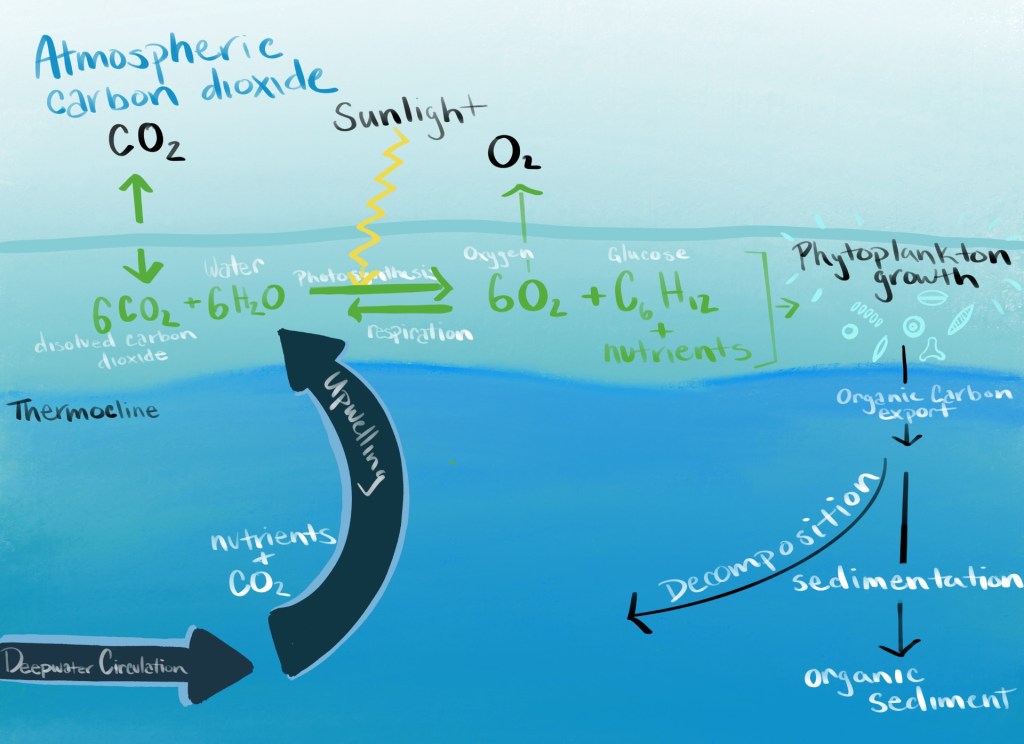
This was a lot of information, let’s take a moment to discuss the process of the biological pump. For this process to work, nutrients must be abundant in the upper ocean. Nutrients are naturally transported from the ocean’s deaths through a process called upwelling. A thermocline is what prevents mixing of surface and deep waters. Upwelling occurs when wind blows across the ocean surface and pushes water away from an area. Then, nutrient-dense, cool water rises to replace the warmer, nutrient-depleted water.
With excess nutrients phytoplankton can grow and thrive transforming water and carbon dioxide with light energy into carbohydrates. In this process carbon dioxide is reduced (or receives electrons) and the surrounding water becomes oxidized (or loses electrons). Oxygen, glucose and nutrients are the products of photosynthesis. Glucose will power the plankton cells and can be turned into other organic compounds. This process will continue as long as there is plenty of nutrients in the water.
If the phytoplankton are not consumed they will die and sink. When plants and animals die they also will sink, decompose and release carbon dioxide and nutrients into the deep ocean. Then once the nutrients in the upper ocean water has been depleted, upwelling will occur and the cycle begins again. Any organic carbon that is remineralized at the surface will be released through respiration and returned to the atmosphere rather than contributing to the biological carbon pump.
Why is This Important?
The important thing to take away from this is that the biological carbon pump helps to mitigate the carbon in our atmosphere. If the biological pump was turned off the carbon dioxide in the atmosphere would increase more than 200 ppm. The question I have is, how would the atmosphere benefit if the biological pump was operating at a maximum efficiency? Would the amount of carbon dioxide in the atmosphere lower more? If there is some noteworthy amount of difference, could this benefit in combating climate change? How (if possible) can we help the biological pump to work at maximum efficiency? Maybe by adding to the concentration of nutrients in the ocean.
References
Tréguer, P., Bowler, C., Moriceau, B. et al. Influence of diatom diversity on the ocean biological carbon pump. Nature Geosci 11, 27–37 (2018). https://doi.org/10.1038/s41561-017-0028-x
Henson, S. A., Sanders, R., Madsen, E., Morris, P. J., Moigne, F. L., & Quartly, G. D. (2011). A reduced estimate of the strength of the ocean’s biological carbon pump. Geophysical Research Letters, 38(4). doi:10.1029/2011gl046735
Atlantic BiogeoChemical Fluxes. (n.d.). Retrieved October 12, 2020, from https://www.rapid.ac.uk/abc/bg/bcp.php
 The Artful Biologist
Leave a comment