
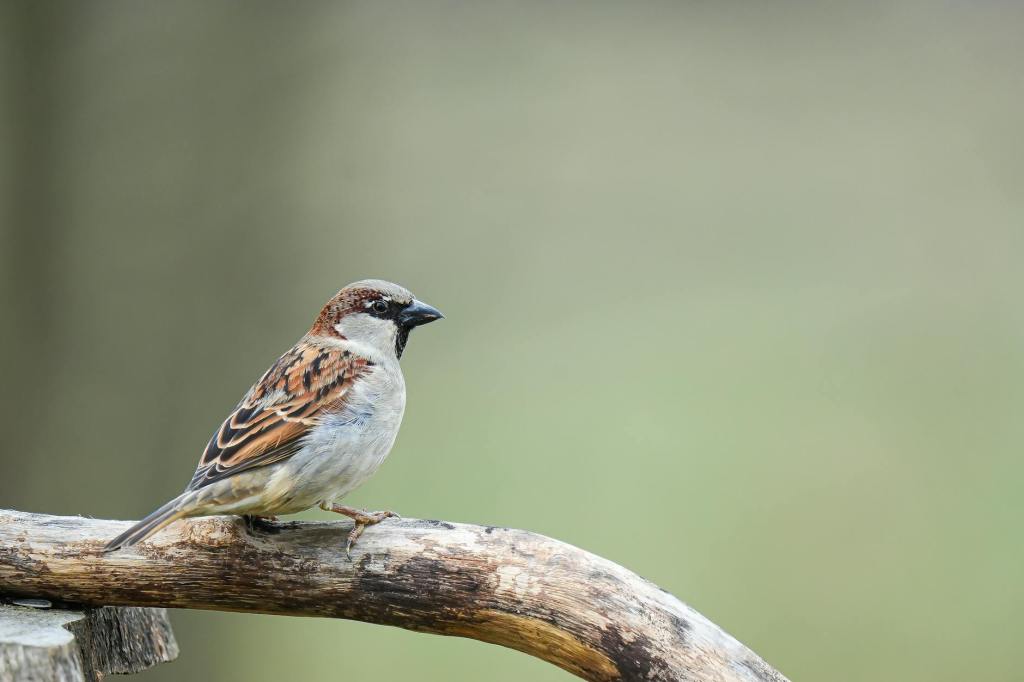
Scientific Name: Passer domesticus
This month I am focusing on researching House Sparrows. Many of you have probably seen this species in your backyard, neighborhood park or in the city. This is one of the most widespread songbird species in the world. The House Sparrow is successful at surviving in so many locations because it has “learned” to associate with humans and has adapted to human development.
Conservation Status:
While this species is of least concern on the IUCN Red List there are rising concerns for it’s gradual population decline in recent years. This of course, is mainly to do with pollution and climate change. However, competition for nesting sites and resources is also a major contributing factor.
Habitat:
The general surroundings for this species can widely vary from cities to farms, from manmade structures to unaltered natural ones. The house sparrow originated on the Middle East and has spread to most of the world.
Behavior:
House Sparrows are foragers, hopping along the ground searching for seeds or insects. Since they are opportunistic feeders, they will forage in garbage containers and can even use automatic doors to enter supermarkets.
As breeding season approaches, males begin displaying to females with raised tails, puffed chests and wings drooped. Males will bow and chirp to attract females. Pairing is initiated by the females. House Sparrows are monogamous, meaning they mate for life and are bonded by their nesting site. Together the parents build a small nest inside an enclosed cavity made of twigs, grass and sadly, trash.
Fun Fact! A House Sparrow’s nest can support over a thousand species of beetles, nest flies and blowflies.
Clutches can have up to 10 eggs but normally comprise four or five eggs. Older parents have higher breeding success than young parents because of their previous experience in protecting nesting sites and ability to lay more eggs during a nesting season. Once hatched, the young leave the nest after about two weeks.
Survival:
The main threats House Sparrows have are wildfires, heat waves, urbanization and predation. Wildfires destroy habitats, and if repeatedly burned, they may never recover. Heat waves in the spring time can pose threats to young birds residing in the nest. Human development poses a risk to bird habitats through pollution and habitat destruction. The main predator for this species are domestic cats. Outdoor cats are a threat to all garden birds, reptiles and other species. Cats have contributed to the extinction of more than 60 species all over the globe.
Relationship with Humans:
As I previously mentioned, House Sparrows are associated with humans. In some cases this bird can have negative impacts on humans by consuming seeds for farming, competing with other native birds, and they can spread diseases. Some benefits House Sparrows have to humans are that they consume insect pests and can be used as a food item.
In the next few weeks I will be taking a look at some studies on House Sparrow evolution, climate change impacts and human interactions. Happy Monday!
References
Doherty, T. S., Glen, A. S., Nimmo, D. G., Ritchie, E. G., & Dickman, C. R. (2016). Invasive predators and global biodiversity loss. Proceedings of the National Academy of Sciences, 113(40), 11261-11265. doi:10.1073/pnas.1602480113
House Sparrow. (2019, December 09). Retrieved November 01, 2020, from https://www.audubon.org/field-guide/bird/house-sparrow
 The Artful Biologist
Leave a comment