
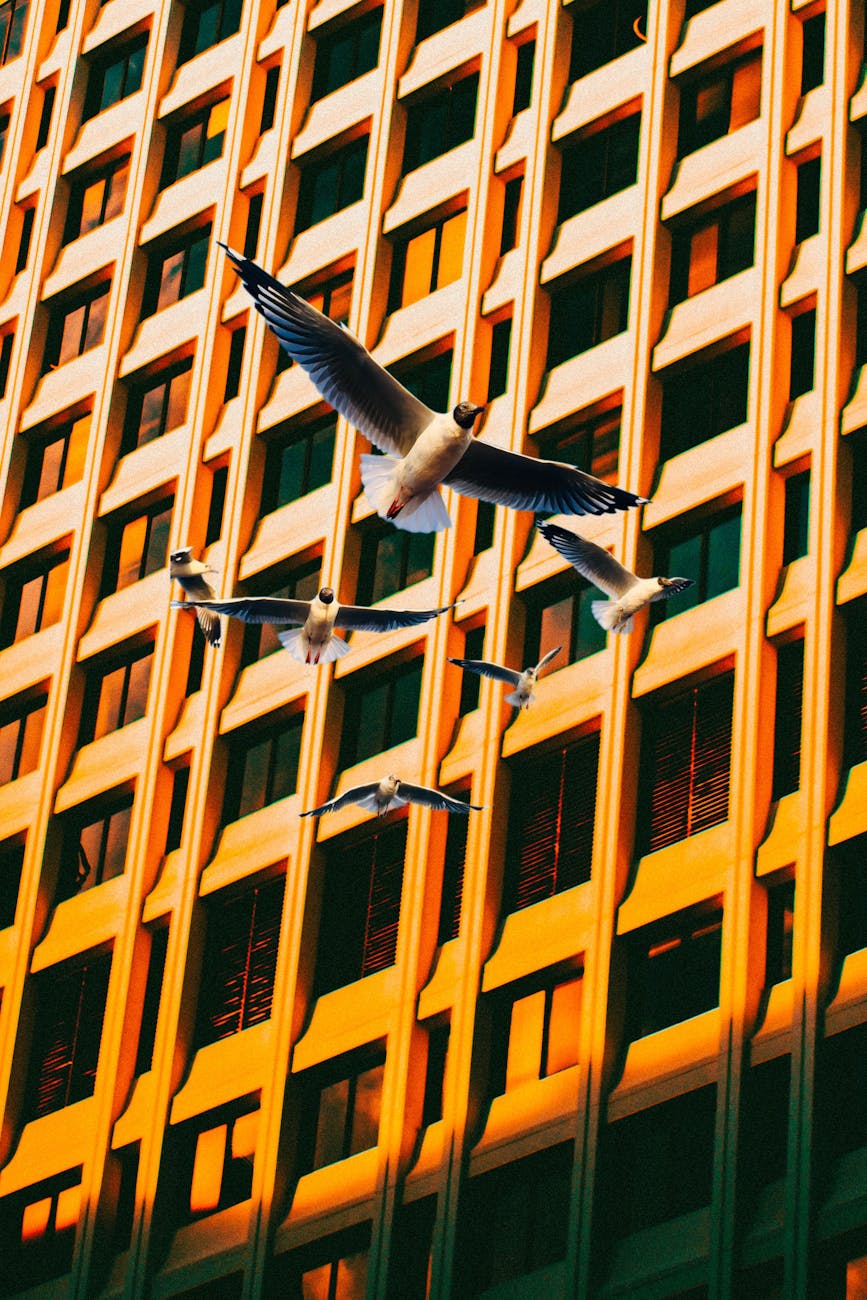
Many millions to a billion of birds die each year from colliding with buildings, wind turbines, power lines, and other human-built structures. Collisions are estimated to be the second greatest human-induced threat to birds. I never realized the severity of this problem. It is impossible to truly know how many birds die from colliding with buildings and structures because they may end up being run over by a car or landing on the roof of a shorter building. Migrating species are most at risk. Within one day this year (2020), Philadelphia saw 1,000 migratory birds collide with buildings causing injury and mortality. From the studies I have read, understanding factors that are contributing to this problem requires extensive surveying.
What Is Happening?
Some building features that are leading to these collision events include glass, light, and vegetation. Since glass is transparent and/or reflective, birds generally do not see it as an obstacle. Songbirds have monocular vision, allowing them to see all around them, especially during flight. Migrating birds are often focused on the ground for navigation or resources rather than where they are going.
During the daytime windows will reflect the landscape or clouds around it creating a hazard for birds. At night the light from within the buildings attracts the nocturnal migrants causing either collisions or entrapment. Songbirds have small eyes that are inadequate for night vision. Regardless, migrating at night is advantageous to songbirds who use stars as a guide and avoid several day-time predators.
Birds can have some constraints that affect their ability to avoid unexpected hazards. Open-air hazards are of concern because they occupy previously predictable environments for flying birds. Open-air hazards are really tall structures like air turbines and communication towers that extend above surrounding landscapes.
One really important detail to take away from this post is that this is not strictly occurring in urban areas with tall skyscrapers. Buildings less than three stories contribute to 56 percent of collision mortalities. As I mentioned there are about a billion birds that die from collisions each year. However, this number does not include the total number of bird collisions. The data are collected by researchers going out early in the mornings to count the number of dead birds around a building. This does not include birds who have collided and were able to fly away. More accurate data collection would include this factor. This could be conducted using a sensor to count the total bird collisions.
This can be Prevented!
How do we reduce these collisions? A visual and auditory signal can be used for collision avoidance with open-air hazards. Projecting a sound and a light can grab the visual attention of a bird and reduce collisions. A good analogy for this idea is a lighthouse. It serves to aid navigation and warn of dangerous areas. Preventing window collisions is more tricky. Humans like the aesthetic of windows therefore the anti-collision technology needs to also be aesthetically pleasing. Previous technology for this is simply barred glass decals. BirdShades, a small Austrian company, has been working to develop a coating for glass that is noticeable for birds but transparent to the human eye. The idea for this is based on the fact that unlike humans, birds can see ultraviolet light. (Humans can only see visible light) The film reflects UV light and ideally warns the bird and causes a change in its course. This could be a great solution for both tall skyscrapers and homeowners concerned about garden songbirds flying into their windows.
By working with leaders and building managers across the country, scientists can inform them of the conservation solutions that would help reduce collision events. It is imperative to keep reaching out and raising awareness about the severity of this problem and all the work that needs to be done.
Since this week is Thanksgiving, I just wanted to thank all my readers who encourage me to continue to write. I am so grateful for all your support. I hope everyone has a safe and happy Thanksgiving!
References
Buildings & Glass. (2018, April 18). Retrieved November 24, 2020, from https://www.fws.gov/birds/bird-enthusiasts/threats-to-birds/collisions/buildings-and-glass.php
McClain, J. (2020, October 08). BirdShades trials yield better methodology for testing bird-window collision deterrents. Retrieved November 24, 2020, from https://www.wm.edu/news/stories/2020/birdshades-trials-yield-better-methodology-for-testing-bird-window-collision-deterrents.php
Loss SR, Lao S, Eckles JW, Anderson AW, Blair RB, Turner RJ (2019) Factors influencing bird-building collisions in the downtown area of a major North American city. PLoS ONE 14(11): e0224164. https://doi.org/10.1371/journal.pone.0224164
Sanchez, C. (2020, October 29). Philadelphia Sees Largest Mass Collision Event in the City in 70 Years. Retrieved November 24, 2020, from https://www.audubon.org/news/philadelphia-sees-largest-mass-collision-event-city-70-years?ms=digital-eng-social-instagram-x-20201100_ig_link_in_bio
 The Artful Biologist
Leave a comment