
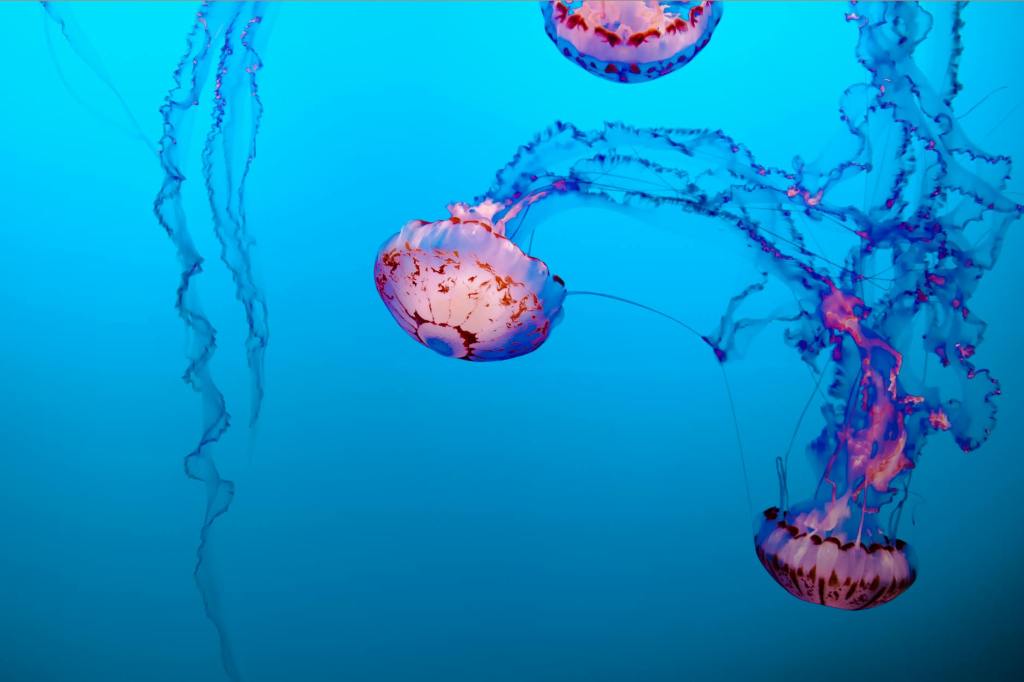
Jellyfish are commonly described as gelatinous animals who drift through the water column using their trailing tentacles to sting prey. Often these creatures are called dangerous and beautiful. Jellyfish and comb jellies look very similar and can easily be confused for the same. They both are ancient animals and have similar effects on the marine ecosystem. However, these species are not as closely related as we thought and have very different life histories. For this introduction, I will refer to them as jellies.
History
Jellies are the earliest known animal to have organized tissues (epidermis, internal gastrodermis, nervous system). The oldest fossil records show an ancestor of modern jellies as long as 700 million years ago. For reference, the dinosaurs first appeared about 230 million years ago. I would say this ancestor evolved sometime in the pre-Cambrian to Cambrian periods.
Fun Fact! Jellies are 95 percent water.
Taxonomy
Jellyfish and comb jellies belong to different phyla. Ctenophora includes the comb jellies and the jellyfish and other jellies belong to the phylum Cnidaria. Today, researchers are still unsure of how closely related these groups are. Some argue that Ctenophores are the most ancient group of animals, evolving even earlier than sponges. However, many biologists agree that ctenophores are the second-earliest branching animal lineage.
Ctenophores
For now, let’s delve into the Phylum Ctenophora and next week we will discuss Cnidarians. The reason Ctenophores are called “comb jellies” is because they have cilia all along their body for locomotion. These comb-like cilia rhythmically beat as they move through the water.
Types of Comb Jelly Body Forms
There are only about 100 species of ctenophores known and fully documented today. The three main groups of comb jellies are Cydippids, Lobates, and Beroids. These groups are mainly distinguished by body shape. Cydippids have a very rounded body shape and branched tentacles. Lobates, which you may have guessed, have two lobes that extend below their mouth and are covered in tentacles. Lastly, Beroids are saclike, having no tentacles, or feeding appendages.
Features and Locomotion
Unlike jellyfish, comb jellies do not have stinging tentacles. Ctenophores are unique because they have sticky cells called colloblasts on their outer epidermis layer which are used for capturing prey. Their cilia (called ctenes) are arranged in eight strips called comb rows. These evenly spaced rows run from their oral to aboral poles. Unlike jellyfish, comb jellies swim in the direction in which the mouth is eating. They can also reverse which direction their cilia pulsate to escape predators.
Bioluminescence
While ctenophores are transparent or colorless, light can be diffracted along the comb rows to produce a rainbow effect. Most ctenophores are bioluminescent. Light is produced by the activation of calcium-activated proteins in photocytes. Photocytes are cells that catalyze enzymes to produce light. Comb jellies glow a brilliant blue or green in darkness. A bright flash in the dark could serve as a defense tactic to scare off predators.
A New Species
On November 20th, 2020, NOAA reported the discovery of a new species of comb jelly. It was actually in 2015 when the ROV Deep Discoverer captured this novel species with a high-definition video. This is the first time scientists have used an HD video to describe a new species. The species was spotted in a canyon not far from the Puerto Rico Trench, about 4,000 meters deep. Using lasers, the scientists were able to measure the length of the species, totaling about 36 centimeters. The body measured 6 centimeters and the tentacles were about 30 centimeters long. It took about 5 years to describe this individual as a new species and genus. Unfortunately, the ROV was unable to get a sample so researchers have not gotten access to the information that is in the genome. The best way to describe this species is a balloon with two strings.
References
Fisheries, N. (2020, November 20). NOAA Scientists Virtually Discover New Species of Comb Jelly Near Puerto Rico. Retrieved December 07, 2020, from https://www.fisheries.noaa.gov/feature-story/noaa-scientists-virtually-discover-new-species-comb-jelly-near-puerto-rico
The Ocean Portal Team Reviewed by Allen Collins. (2019, March 22). Jellyfish and Comb Jellies. Retrieved December 07, 2020, from https://ocean.si.edu/ocean-life/invertebrates/jellyfish-and-comb-jellies
G.R. Harbison, L.P. Madin, N.R. Swanberg, On the natural history and distribution of oceanic ctenophores, Deep Sea Research, Volume 25, Issue 3, 1978, Pages 233-256, ISSN 0146-6291,
https://doi.org/10.1016/0146-6291(78)90590-8.
 The Artful Biologist
Leave a comment