
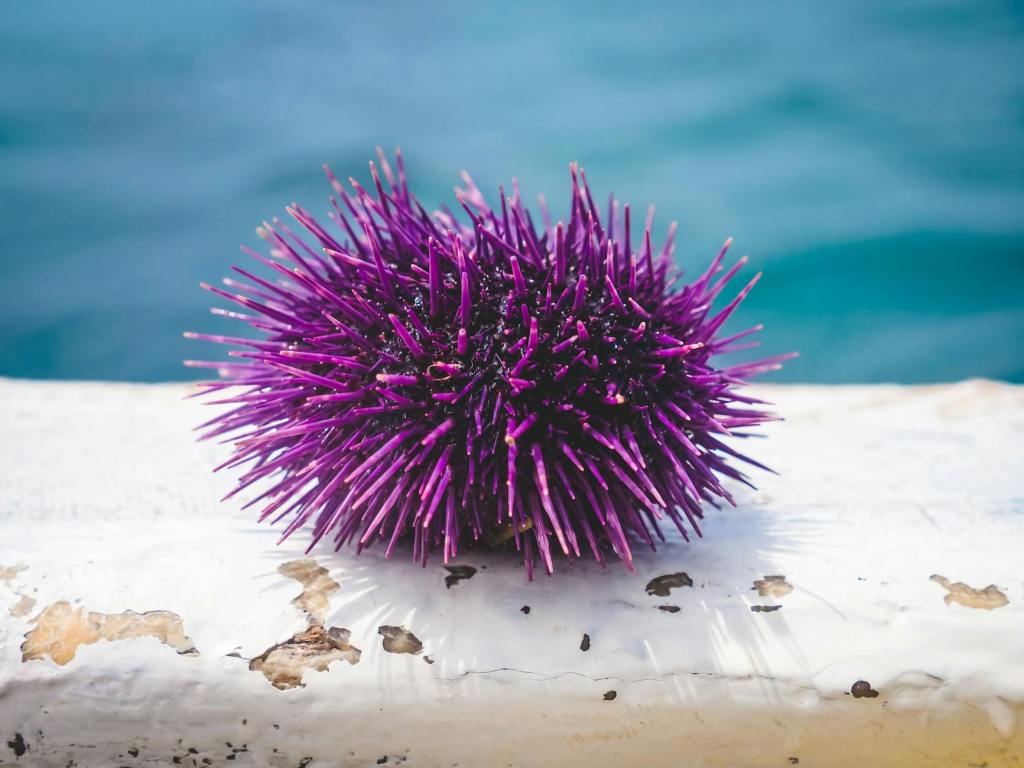
Sea Urchin Basics
Sea urchins belong to the same class as sea stars, Echinodermata. Like sea stars, sea urchins use tube feet to move around and have spines for protection. They feed primarily on algae but will also consume other sessile invertebrates. Sea urchins have played an important role in scientific research. Since the 19th century, biologists have been using sea urchins as model organisms in developmental biology. In college, I spent a semester studying developmental biology and used sea urchins in my experiment to understand the environmental effects on sea urchin gametes and embryo development. The reason urchins are commonly used in developmental biology studies is because their embryos are easy to observe, and their eggs are transparent, so scientists have been able to study sperm cells fertilizing the egg. Other research studies such as longevity and genetic studies use sea urchins as well.
Combating Invasive Algae
This week I came across an interesting article about how two algal species have invaded Hawaiian coral reefs and biologists are now breeding sea urchins to help combat their overgrowth. The invading species are Kappaphycus alvarezii and K. striatum. Both are commercially important and were initially brought to Hawaii for breeding purposes in 1974. Unfortunately, these algae made their way into the coral reef environment and are smothering corals. The algae cover the coral blocking sunlight from their photosynthesizing symbionts, Zooxanthellae.
Scientists from Anuenue Fisheries Research Center are actively breeding Tripneustes gratillanative, native sea urchins to combat the algal overgrowth in Kaneohe Bay. These sea urchins are consuming the algae while still contributing to the coral reef’s natural food chain. About 25,000 urchins are bred and released each month. Ideally, the scientists are aiming to have four sea urchins per square meter. This will require continual breeding and replacement as the urchins are consumed by octopuses and fish. The benefit of breeding the urchins in captivity is it allows for more successful development and better algal growth control.
Breeding Process
Divers collect random adult urchins from the reefs to keep the population diverse and bring them back to the lab for spawning. The sperm and eggs are collected and without harm to the urchins and placed in filtered seawater. In only a day, biologists can observe the embryos and start to estimate how many urchins they will have. After about a month, the larvae are moved to larger tanks to feed on microalgae and develop into juveniles. After another month or two, once the urchins have reached 5 to 7 millimeters in diameter (or about pea-sized), they can consume macroalgae and are eligible to be released into the reef ecosystem.
There were other proposed methods to combat the overgrown algae like the “Super Sucker” vacuum. However, the urchin breeding program has proven to be more economical and has fewer unnatural impacts on the coral reef environment. The urchin breeding program is a more sustainable solution for managing invasive algae. Nonetheless, there are challenges that biologists are facing, including properly releasing the urchins into the correct geographical location.
For more information on this project and how it was funded check out: https://www.fisheries.noaa.gov/feature-story/how-tiny-sea-urchins-are-saving-kaneohe-bay
References
Platt, J. (2011, February 02). Sea urchins bred to Eat INVASIVE seaweed in Hawaii. Retrieved March 08, 2021, from https://blogs.scientificamerican.com/extinction-countdown/sea-urchins-bred-to-eat-invasive-seaweed-in-hawaii/
US Department of Commerce, N. (2017, March 13). Sea urchins helping to combat invasive algae. Retrieved March 08, 2021, from https://oceanservice.noaa.gov/news/mar17/sea-urchins-hawaii.html
Fisheries, N. (2018, August 01). How tiny sea urchins are saving kāne’ohe bay. Retrieved March 08, 2021, from https://www.fisheries.noaa.gov/feature-story/how-tiny-sea-urchins-are-saving-kaneohe-bay
 The Artful Biologist
Leave a comment