
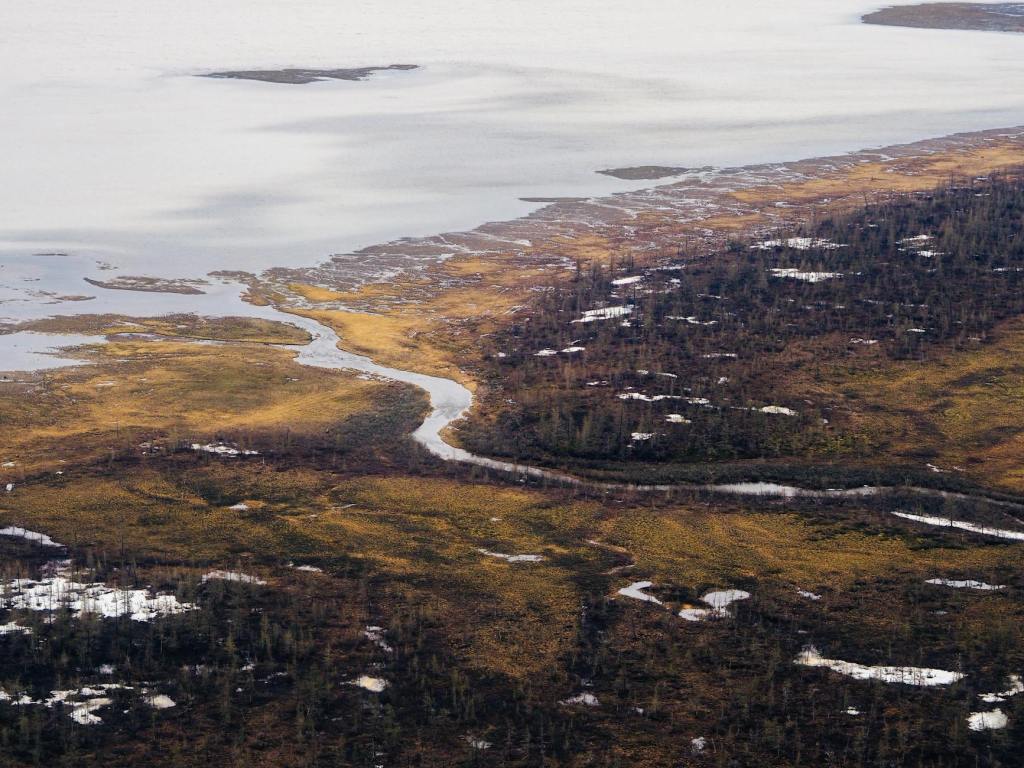
As the world struggles to keep global temperatures from surpassing 1.5°C, a hidden danger threatens to accelerate climate change: permafrost thaw. Permafrost, the frozen ground covering vast regions of the Arctic, is rapidly thawing, releasing vast stores of greenhouse gases (GHGs) into the atmosphere. Yet, despite its profound implications for the global climate, permafrost emissions remain largely unaccounted for in international climate agreements.
In my latest article, Thawing Grounds, Rising Stakes: The Importance of Including Permafrost Emissions in Climate Policy, published in The Arctic Institute’s Planetary Series 2025, I examine why permafrost emissions are missing from Nationally Determined Contributions (NDCs) under the Paris Agreement and what can be done to correct this oversight.
Why Are Permafrost Emissions Overlooked?
Most climate models and policies focus on emissions from human activities, such as fossil fuel combustion and deforestation, while natural carbon feedbacks—like those from thawing permafrost—remain uncounted. This exclusion is due in part to:
- Geographic and political limitations: Countries without permafrost do not prioritize its emissions in their climate strategies.
- Measurement challenges: Permafrost emissions are difficult to quantify due to unpredictable thaw patterns and gaps in scientific monitoring.
- Lack of political will: Many nations hesitate to include permafrost emissions in NDCs due to their natural origin and concerns about the complexity of accounting for them.
The Consequences of Inaction
Permafrost stores an estimated 1.4 trillion metric tons of carbon—nearly double the carbon currently in the atmosphere. As it thaws, it releases carbon dioxide and methane, potent GHGs that further warm the planet in a dangerous feedback loop. If we fail to incorporate permafrost emissions into global climate policies, we risk underestimating future warming, setting ourselves up for more severe climate disruptions than currently anticipated.
A Call to Action
Governments, scientists, and policymakers must work together to close this climate policy gap. Steps to achieve this include:
- Expanding scientific monitoring and modeling to improve emissions estimates.
- Encouraging Arctic nations to incorporate permafrost thaw in their NDCs.
- Pushing for IPCC guidance on permafrost emissions in future climate assessments.
- Strengthening international cooperation on Arctic research and mitigation strategies.
The permafrost crisis is not just an Arctic problem; it is a global threat with serious implications for climate stability, infrastructure, and Indigenous communities. To learn more about the urgent need to integrate permafrost emissions into climate policy, read my full article here.
- Bykova A (2020) Permafrost thaw in a warming world: The Arctic Institute’s permafrost series fall-winter 2020. The Arctic Institute, https://www.thearcticinstitute.org/permafrost-thaw-warming-world-arctic-institute-permafrost-series-fall-winter-2020/. Accessed on 12 September 2024
- Schuur EAG, Abbott BW, Commane R et al. (2022) Permafrost and Climate Change: Carbon Cycle Feedbacks from the Warming Arctic. Annual Review of Environment and Resources 47: 343-371. https://doi.org/10.1146/annurev-environ-012220-011847
- Natali SM, Holdren JP, Rogers BM et al. (2021) Permafrost carbon feedbacks threaten global climate goals. Proceedings of the National Academy of Sciences 118(21): e2100163118. https://doi.org/10.1073/pnas.2100163118
 The Artful Biologist
Leave a comment