
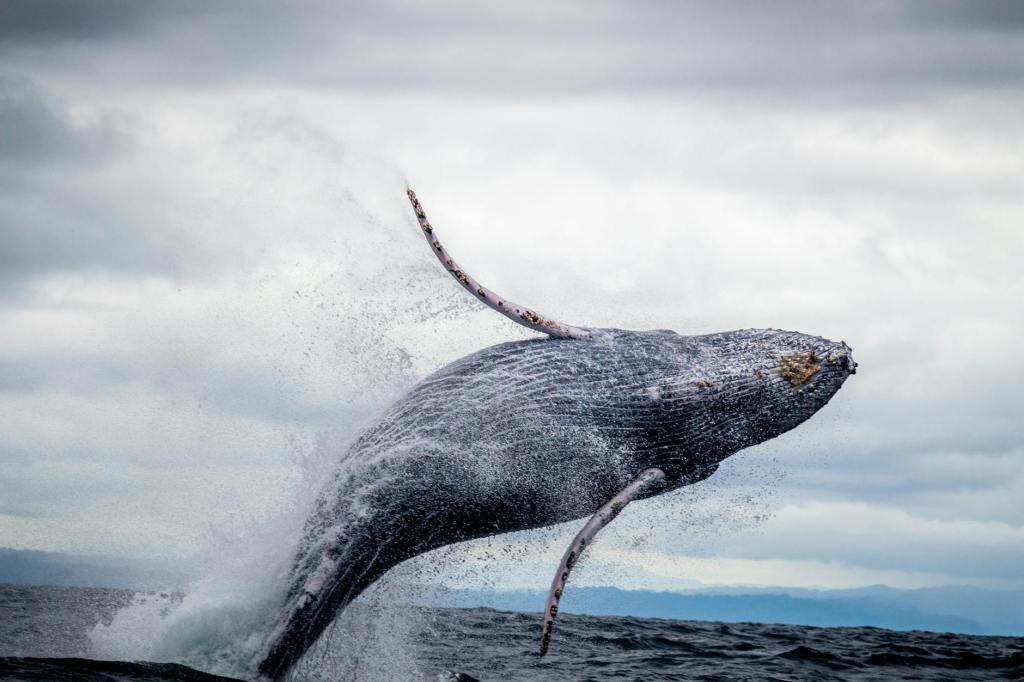
Conservation
The North Atlantic Right Whales get their name from early whalers who referred to them as the “right whale” to hunt. North Atlantic Right Whales are buoyant and often are found feeding at the surface, for these reasons they were heavily targeted. North Atlantic Right Whales have been listed on the Endangered Species Act since 1970 and are an IUCN (International Union for Conservation of Nature) Red List endangered species. It is estimated there are only about 400 individuals left, including 100 breeding females. However, the death rate for this species is outpacing the birthrate. Since 2017, there have been only 12 births. Unfortunately, I was not able to find more information to answer why there have been only 12 births in the last three years. I speculate the whales are not reproducing because of higher stress levels from anthropogenic impacts or that there have been changes in their normal diet due to climate change.
Threats
The number one threat this species faces today is collisions with vessels, or human interaction through boat strikes or gear entanglement. Blunt force trauma and cuts from propellers can lead to beaching and/or death due to starvation and infection. North Atlantic Right whales migrate north and south for feeding and birthing seasons; nevertheless, this cuts through most of the major east coast shipping lanes. Sadly, many of these collisions go unnoticed or unreported. In February 2020 a 19 year-old female named “Dragon” was spotted entangled in rope and a buoy. Experts said it was a dangerous case for the whale and response team. This case was of top priority since Dragon is one of the breeding females.
Boat strikes and entanglement are also quite common in many other marine species. Recently in June 2020 there was a reported sighting of a Fin Whale whose tail fins had be amputated. Experts concluded the damage was from either a boat strike (propeller cut) or from being tangled in fishing gear. Most likely this whale is suffering from starvation and is unlikely to survive. Vessel collisions and entanglement in fishing gear are serious threats. There are solutions to these threats readily available, they just need to be put into action and enforced.
More information on the Fin Whale
Another common threat to North Atlantic Right Whales is noise pollution. Whales are very social animals and make noise to communicate within their pods for locating food and each other. Anthropogenic sound can interrupt this communication and normal behavior thus leading to stranding and death. Scientists have been studying these unnatural noises to better understand the effects on not only whales but all marine mammals.
Action
So, this being said, I think it is evident that action must be taken if we want to preserve this species. Luckily the National Oceanic and Atmospheric Administration (NOAA) has made a lot of effort in mitigating the risks these whales face. Some of their efforts include providing modified shipping routes for major east coast shipping and administering to keep the international ban on hunting. The National Marine Fisheries Service requires that all ships 20 meters in length or greater reduce their speed when crossing through areas where these whales reproduce, feed, and migrate to 10 knots (~11 miles per hour). Other actions that can aid in species preservation are educating mariners and continuing scientific research. It is so important for scientists to continue to monitor this species population and migration patterns. Through research we can maximize the efforts to protect individuals and their habitat from danger.
How can YOU help?
I hope that if there is anything you as a reader can take away from this, it’s that you can do your part to take action in helping to preserve not only North Atlantic Right Whales but all other marine mammals and animals. Even if you are land-locked and do not plan on visiting the ocean, you can always pass on these tips to others you may know who are.
1. Report Sightings
It is very simple to report any sighting using the Whale App. Whale Alert is a company who focuses on reducing lethal whale collisions by providing data to other networks like NOAA and non-profit organizations. By reporting whale sightings, you can help contribute data to science research that will benefit whale conservation.
2. Keep Your Distance
NOAA fisheries prohibit approaching North Atlantic Right Whales. Stay 500 yards away from any whale spotted, even if it is injured. This ban includes all vessels including boats, surfboards, kayaks etc. If you do witness any persons violating this, you can call the NOAA Fisheries Enforcement hotline at (800) 853-1964 and report this federal marine resource violation. I believe this number is only for the United States so be sure to check international fisheries enforcement.
3. Report Distress
If the unfortunate comes along and you happen upon a sick, injured, entangled or dead whale (or any marine animal) please report them. You should never approach or attempt to help a whale or other marine animal yourself as it can cause harm to both you and the animal. There are many organizations around the coast who have trained professionals and scientists who will be able to respond and take the appropriate action. You can use an app to immediately report a stranding called Dolphin & Whale 911. Reports through this app immediately go to authorized emergency responders.
4. Be Informed, Get Involved, Tell Your Friends!
Education is the most important action you can take. Stay up to date with right whale conservation management plans and participate in public meetings. You can share your perspectives with the Take Reduction team who’s focus is to mitigate the risk marine mammals face from fishing gear. Also, I encourage you to vote! Recently President Donald Trump signed a proclamation allowing commercial fishing in the Atlantic Ocean’s only fully protected marine sanctuary. Paul LePage, former governor of Maine, falsely informed Trump that fishing does not harm whales and that there have not been any reports of whale mortality in Maine waters in the past two decades. This led to Trump dismissing any arguments that fishing can cause harm to whales and other marine species. Having a political leader who values science research and education can really aid in staying on track to preserving not just North Atlantic Right Whales but all wildlife.
References
Fears, D. (2020, July 9). The North Atlantic right whale is the face of an extinction crisis, report says. Washington Post.
Silber, G. K., & Bettridge, S. (2012, August 28). Reducing Threats to Right Whales. Retrieved July 10, 2020, from https://www.fws.gov/endangered/news/bulletin-summer2009/reducing-threats-to-right-whales.html
Fisheries, N. (n.d.). North Atlantic Right Whale. Retrieved July 10, 2020, from https://www.fisheries.noaa.gov/species/north-atlantic-right-whale


 The Artful Biologist
Leave a comment