
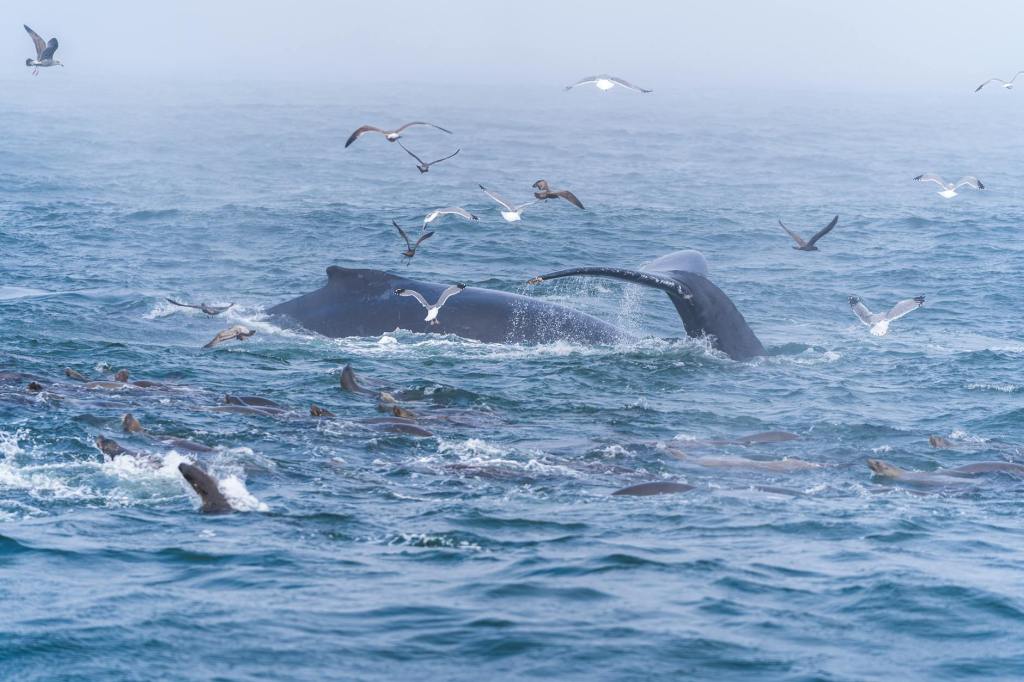
Foraging Rate and Behavior of North Atlantic Right Whales
Most of the current research being published about North Atlantic Right whales is about tracking their migration and how climate change and human interaction are causing increased mortality rates. While I could go on for many more blog posts about the importance of conservation efforts and law enforcement, this week I wanted to focus on a more biological study. The study I will be referencing was published in 2019 by Julie Marine van der Hoop et al, which focused of the foraging rates and behaviors of North Atlantic Right Whales.
In the spring and summer months North Atlantic Right Whales spend their time foraging for food to fuel up and prepare for their breeding months. The location of where these whales feed changes from year to year and this is related to the changes in food supply. It is critical to evaluate the study and understand the energetic consequences of changing feeding habitats and human stressors because North Atlantic Right Whales are an endangered capital breeding species. Capital breeding means that a species will use energy stores built up before reproduction to breed. It is important for this species to eat high-energy density foods to accumulate lots of energy over a short couple of months. This energy is stored for future migration, calving, and can be a source of buffer against human caused stressors. High-energy foods are beneficial to dependent calf (juvenile whale) growth and aide in energy recovery for lactating females. Their diet consists mainly of lipid rich copepods called Calanus spp. and other planktonic organisms.
Copepods [koh-puh-pod] are exceedingly small crustaceans ranging from 1-2 millimetres that float along the water column. Copepods are particularly important to the marine food chain. These tiny crustaceans feed on microscopic algal cells and in turn feed small or larval fish and filter feeding whales (balaenids). Copepods link primary producers and other low trophic levels with higher level consumers. Whales will target patches of copepods ranging from 103-105 copepods per cubic meter at depths of 100-150 meters. At this depth roughly 6-kilometer patches containing copepods with energy densities above 15 joules per cubic meter develop. Within these large patches, concentration and energy density can vary on spatial scales of 500 meters. North Atlantic Right Whales, like all other balaenids, filter feed by propelling themselves forward with an open mouth. The water moves parallel along the inner surface of their baleen plates, a process called cross-flow filtration. This process concentrates the copepods while slowing the overall flow of prey-laden water through the mouth, to then be swallowed. Fused vertebrae that help maintain rigidity while swimming with an open mouth is a morphological adaptation North Atlantic Right Whales have for their high-drag foraging method.
Fun Fact! In the Disney Pixar movie “Finding Nemo” Marlin and Dory are sucked into a balaenid whale and while hanging on to its tongue, they see that the whale has a uvula in the back of his throat. However, animals do not have true uvulas, only humans do.
How come North Atlantic Right Whales can survive on such specific prey, constrained to a specific space and time of the year? Unfortunately, I could not find an answer to this. Researchers are lacking an understanding of this unknown. It is difficult to measure feeding depths and a whale’s speed while filtering. High-resolution acoustic biologging tag data can and has provided some insight into the fine scale movements and behavior while foraging.
Purpose of the Study
This study used DTAGS to quantify swimming speeds and answer questions relating to foraging behavior. DTAGS are miniature sound and movement recording tags that are specially designed for use in marine mammals. These devices are resistant to deep water pressure and have the capacity to record and save the substantial acoustic and movement data. The questions this study looked to answer where:
- How fast do right whales filter? Do whales swim faster to maximize their feeding time at the optimal depth?
- Do right whales show the same characteristic gait patterns (pace) other ram filter feeders have during foraging dives?
- Are pauses in fluking (when the whale’s tail is at the surface) consistent in their timing or variable in duration and filtered volume?
- Are diving behaviors and foraging biomechanics linked? It was hypothesized that if fluking bout duration is inversely related to prey density, and if right whales maximize their diving behavior to forage within high‐quality patches, dives with shorter bouts would be longer.
Methods
This study used DTAGs to record the acoustic environment and swimming behavior of North Atlantic Right Whales in the Bay of Fundy, Canada during late-summer foraging season. Researchers were able to distinguish foraging and non-foraging dives based on the bottom time of the individual. The DTAGs have an external sensor to measure the passing water flow, and with adjustments to average speed according to the pitch angle (diving down or swimming horizontally) the individual’s speed was estimated. The amount of filtered water was assessed using a model that determines the gape (mouth opening) based on the individual’s size. The volumetric filtration rate was estimated by integrating the swimming speed and gape of each whale for bout and dive duration.
Results
In summary what the study found was that North Atlantic Right Whales slow down, but less than other species. Their faster pace was thought to increase the whale’s filtration rate but because North Atlantic Right Whales have a smaller gape it does not compensate. Instead, these whales must feed on higher densities of prey. On average the whales in this study filtered 3,211 (±874) cubic meters of water per hour during complete foraging dives. This study, unlike others, did account for the variation in gape size due to age. Previous studies who did not account for this difference may have resulted in underestimates of the volumes of water filtered and subsequent prey consumed by adult whales. The study found a consistent foraging behavior where individuals performed repeated foraging dives to a consistent depth for a duration of greater than 10 hours. The study also found that there were slight adjustments in depth made while the whale was feeding which suggested that these whales can detect fine‐scale variations in prey density and adjust their foraging behavior accordingly. The whales had such a high maximum feeding rate which may account for why they are able to acquire a large proportion of their total annual energy intake in the months when copepods are at their highest energy densities, and when and where they are abundant.
The technology used in this study combined with areal photography could really help scientists understand when and in what areas North Atlantic Right Whales are obtaining sufficient energy resources. This data can also help conservation efforts and fishery management in understanding their foraging behaviors. Lastly studies like this can help us to regulate the health of the North Atlantic Right Whale population based on body condition. Body condition is affected by prey availability and energy content which are necessary for the survival and recovery of the species.
References
Hoop, J. M., Nousek‐Mcgregor, A. E., Nowacek, D. P., Parks, S. E., Tyack, P., & Madsen, P. T. (2019). Foraging rates of ram‐filtering North Atlantic right whales. Functional Ecology, 33(7), 1290-1306. doi:10.1111/1365-2435.13357

 The Artful Biologist
Leave a reply to Janet Triggs Cancel reply