
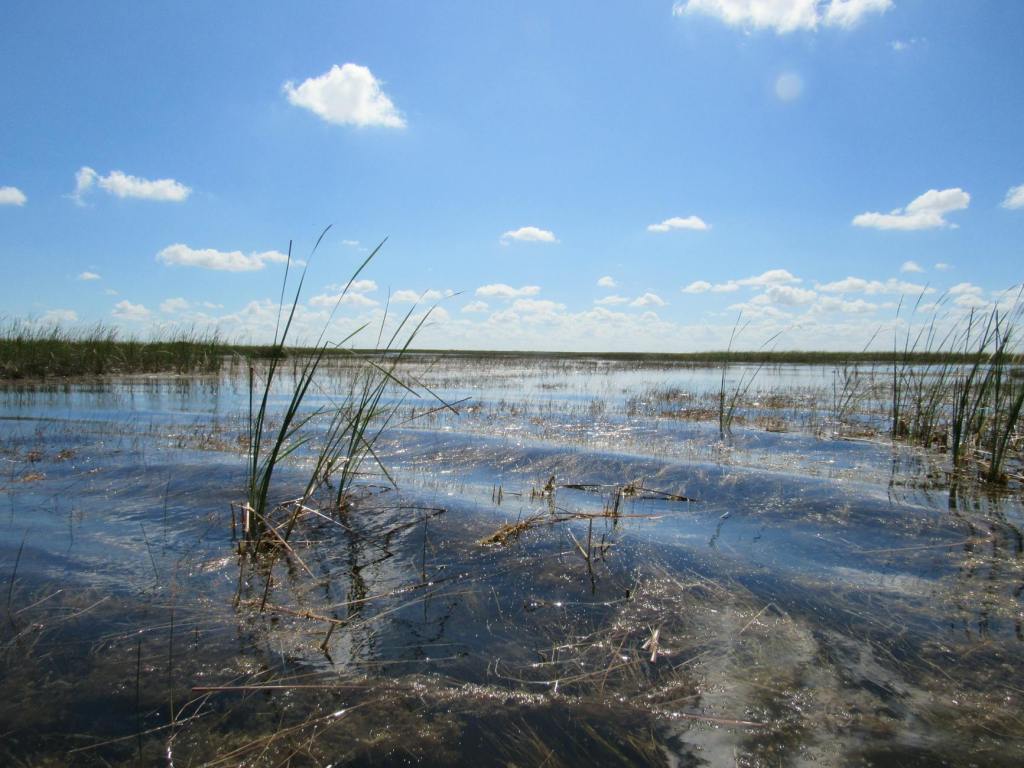
History of the Everglades
The Everglades is the most widely recognized wetland spanning two million acres in southern Florida, USA. Over thousands of years this ecosystem developed into an intricate and well-balanced system from rain and the free-flowing waters of the Kissimmee River towards Lake Okeechobee and southward. During rainy or wet season, fresh water floods and flows south into many habitats. The Everglades originally had a large diverse ecosystem with habitats connected by water and wetlands. In the early 1900’s developers began to drain the everglades to make more agricultural and residential land. Several natural disasters caused dam destruction and major storm surge resulting in over 3000 deaths and a tremendous financial loss. These disasters lead to constructing the Hoover Dike and federal presence in Florida water management.
The water management construction resulted in immense damage that severely impacted the ecosystem and the species its supports. Canals and levees were put in place to contain 32% of the Everglade system. Physical structures like the levees divided marsh lands limiting the movement of many species. Canals created a deep-water ecosystem which limited the a major food source for wading birds and other species who forage in shallow waters. Loss of both land and resources affected all species in the Everglades. Major population declines in local and migratory bird populations were observed as an effect of these losses.
In 1947, the Everglades became a national park supported by scientists, conservationists, and other advocates in hope of preserving and preventing further degradation to the ecosystem and its inhabitants. To restore the Everglades, the U.S. Congress created the Comprehensive Everglades Restoration Plan (CERP) in 2000. It was expected this plan would cost over $16 billion and take several decades to complete.
Spoonbills as Restoration Indicator
In order to have successful ecosystem restoration, ecological monitoring is essential. There are certain species in every ecosystem that can act as indicators of the overall health of the system. A good indicator species is one that:
- represents the system
- integrates system responses
- clearly responds to system changes
- can be effectively and efficiently monitored
- can be easily communicated
The Roseate Spoonbill is a great indicator species for the Everglades. This species has been monitored for well over 80 years. Spoonbills respond to hydrology and prey availability changes that can be observed by monitoring their reproduction. Roosting locations, number of nests and nesting success all indicate positive or negative responses to food availability and land availability. As I discussed last week, Roseate Spoonbills required a lot of energy for successful nesting, which means lots of fish, resources, and available space. Prey abundance can be a function of hydrological conditions like salinity and depth. Roseate Spoonbills can offer more accurate data when compared to other species in wetland habitats. Roseate Spoonbills nest in mangroves and are not able to be viewed from in the air. Therefore, field researchers are forced to go into their habitat to collect data. Thus, the data are more accurate.
How are the Everglades Today?
Today (2020) we have only recovered about 50% of the historic water flow through the Everglades, and the Everglades remain only half its original size. The ecological disconnection from the early 1900’s has resulted in a loss of 1.7 billion gallons of fresh water flow each day into the Gulf of Mexico and Atlantic Ocean. There has been a decline in water quality and saltwater has intruded into groundwater resources owing to decreased hydraulic pressure.
A loss in biodiversity and reduced populations of native plant and animal species has been observed due to the degradation of the Everglades. Loss of predator species has allowed for invasive species to take over, causing competition with the native species for space and resources. There have only been very few valuation studies on the Everglades despite the ecological significance. If more studies were available, policy makers could make better informed decisions and actions regarding Everglades restoration.
Over the past five years, an average of $230 million has been spent on CERP. This is truly a small value when the total economic benefits of restoring the Everglades would be greater. For example, a project resulting in a 10% increase in American Alligators, wading birds, spotted seatrout and other organisms, and a 50% reduction in discharges would cost around $1.3 billion per year. This value is substantially more than the amount currently being allocated to the restoration project.
Are Florida citizens willing to pay for these restoration efforts? I think this question is very circumstantial. A study found that many Florida residents would be more likely to support Everglades restoration projects if the links to species protection were highlighted. Many people care about continuing the existence of endangered species. I think there would be even more interest and support in Everglades restoration projects if people understood the economic services they provide and what the monetary value for that looks like.
References
Lorenz, J. J., Langan-Mulrooney, B., Frezza, P. E., Harvey, R. G., & Mazzotti, F. J. (2009). Roseate spoonbill reproduction as an indicator for restoration of the Everglades and the Everglades estuaries. Ecological Indicators, 9(6), S96-S107. doi:10.1016/j.ecolind.2008.10.008
Stainback, G. A., Lai, J. H., Pienaar, E. F., Adam, D. C., Wiederholt, R., & Vorseth, C. (2020). Public preferences for ecological indicators used in Everglades restoration. Plos One, 15(6). doi:10.1371/journal.pone.0234051
Gunderson, L.H. & Loftus, W.. (1999). Everglades.

 The Artful Biologist
Leave a reply to Anton Schulzki Cancel reply