

Phylum: Echinodermata (spiny skin)
Class: Asteroidea
There are so many unique kinds of sea stars. There are common sea stars who have five arms and others like the sun star who can have 40 arms, there are brittle stars and basket stars. Sea stars can come in all different sizes and colors but are all spiny skinned, marine invertebrates. Sea stars -sometimes referred to as starfish- are closely related to sea urchins, sea cucumbers, sand dollars, and sea lilies. There are approximately 7,000 species of echinoderms, and 2,000 of them are sea stars.
How They Move
If you have looked at the underside of a sea star, then you may have noticed hundreds of tiny suction cup feet. These are called tube feet. Sea stars have a hydraulic system for locomotion called the water vascular system. Water is pumped into the body through a sieve called the madreporite on the aboral surface. Then, the water is moved through a series of canals to propel their tube feet forward or to grasp onto their prey. If you have never seen this before, I recommend visiting a local aquarium or tide pool because it is fascinating watching how sea stars move around.
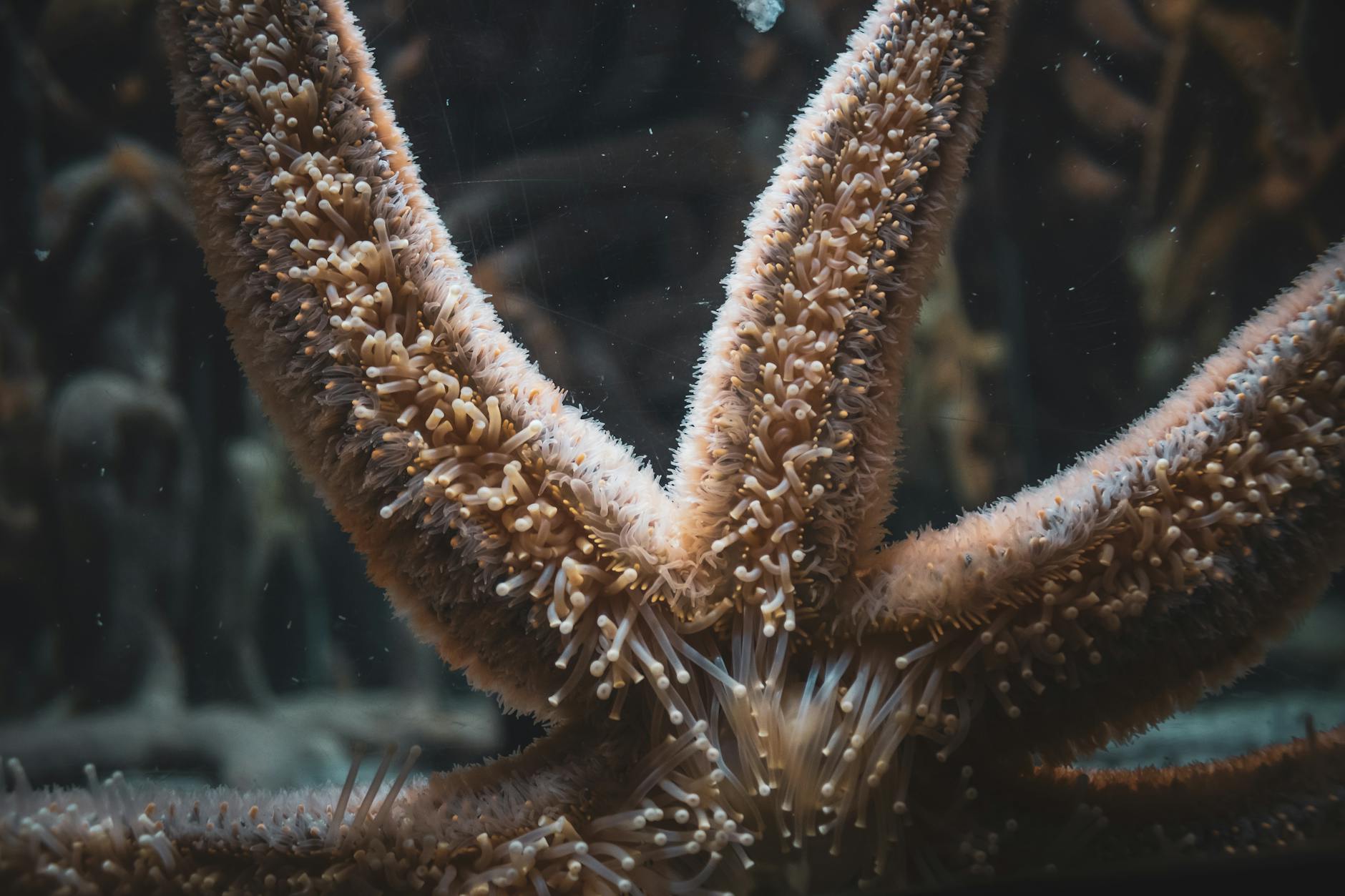
How They Eat
Sea stars are carnivores and most prey on sponges, snails, bivalves and other small animals. Sea stars consume their prey by everting their stomach through their mouth. Digestive enzymes are released onto the prey to start digesting it. The partially digested prey and stomach are then retracted back inside the sea star. Since sea stars have an external digestion, they can hunt prey larger than their mouths.
Fun Fact! Sea stars can regenerate lost arms! This is useful when injured by a predator. Since most of a sea star’s major organs are in its arms, it is even possible to completely regenerate a new star from a single arm.
Ecology
Sea stars are benthic organisms that can be found all over the world in deep or shallow saltwater basins. Some of their common habitats include tidal pools, coral reefs, kelp forests and seagrass beds. Sea stars are a keystone species. Keystone species are the organisms critical to the survival of the ecosystem they reside in and its other inhabitants. This phenomenon was first introduced by Robert T. Paine in 1969. Paine studied sea stars on the coast of Washington state and observed how the mussel population was kept balanced by the sea stars, thus allowing other species to thrive. In a separate experiment, sea stars were removed from their habitat and mussel populations over grew the entire space. This caused the diversity of organisms within this environment to reduce radically. Paine concluded that preserving and protecting keystone species can help maintain diversity and the overall health of an ecosystem.
Human Relation
Sea stars, while integral to their ecosystem, compete with recreational and commercial fishing. A sea star can consume 50 young clams in only a week. Sea stars themselves are not commonly consumed by humans. This is mainly because their body is mostly made of spiny ossicles and some species contain chemical compounds that taste bad. However, in China, Japan, and Micronesia they are occasionally eaten. Sea stars however are often collected and sold as souvenirs to tourists. Please do not buy sea stars or other dried animals for souvenirs. Some of these organisms face endangerment or extinction as a result of harvesting for tourism. These beautiful creatures belong to the sea.
Sea stars are an important species to researchers. As a model organism, they are closely related to chordates, resilient, and easy to breed, making them ideal for studying reproduction and developmental sciences. Since sea stars have the ability to regenerate and clone, they have recently become a popular species for stem cell research.
In the following weeks I will be focusing on the negative impacts the crown-of-thorns sea star has had on coral reefs, threats that sea stars face, and recent studies on neuropeptides as regulators of feeding in sea stars.
References
Echinodermata. Available at: http://tolweb.org/Echinodermata/2497. (Accessed: 30th August 2020)
Semmens, D. C. et al. Discovery of a novel neurophysin-associated neuropeptide that triggers cardiac stomach contraction and retraction in starfish. J. Exp. Biol. 216, 4047–4053 (2013).
Mills, L., Soulé, M., & Doak, D. (1993). The Keystone-Species Concept in Ecology and Conservation. BioScience, 43(4), 219-224. doi:10.2307/1312122


 The Artful Biologist
Leave a comment