
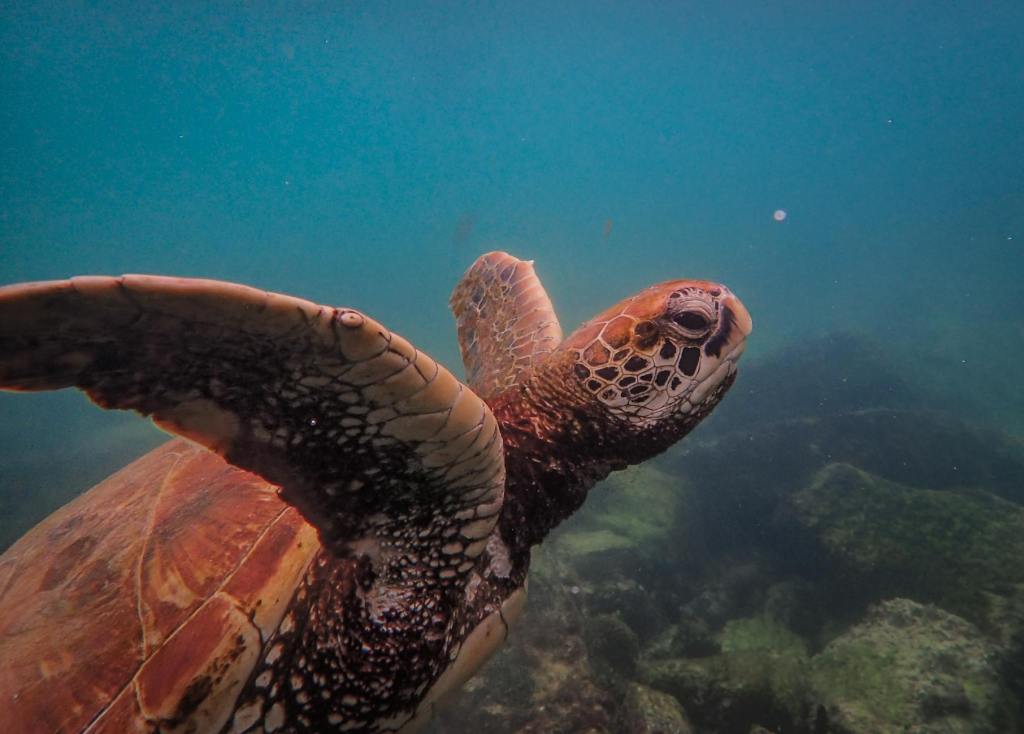
Last week I mentioned disease as one of the leading threats to green sea turtles. Fabropapillomatosis (FP) is a very infectious disease caused by a herpesvirus. Herpesviruses are part of a family of viruses that contain DNA and cause infections in humans or animals. FP affects all species of sea turtles worldwide but is mainly prevalent in green turtles living in warmer, tropical waters. Many claim the disease is correlated to pollution runoff and biotoxin-producing algae. FP is thought to cause external and internal tumor growth. Tumors can vary in size and number. These tumors can severely impact a turtle’s mobility feeding and vision since they arise on the neck, eyes, and base of flippers. Internal tumors grow on a turtle’s kidneys, lungs, and/or heart.
History
FP was first described by Florida scientists in the early 1920’s. From 1980 – 1998 stranded sea turtles with FP were documented only in southern Florida. In the mid-1950s Hawaii had its first documented case of FP. Since the late 90’s scientists have documented FP cases in all major oceans and further north of 29°N latitude.
Rehabilitation
FP can suppress a sea turtle’s immune system making them more vulnerable to infectious diseases. For this reason, only about 30% of turtles recover from FP. Marine veterinarians have worked towards removing tumors from sea turtles using laser surgery. FP tumors are infectious, so biosecurity is very important when handling infected turtles. Tumor removal greatly improves the recovery rate for turtles. In severe cases or cases with major internal tumor growth, humane euthanasia is recommended.
The Unknown
Sadly, there is little knowledge about how the virus is transmitted, if there is a true correlation between ecosystem health and turtle health, and whether the virus is the cause of tumors. It is important to study FP to improve sea turtle conservation but also to understand the health of coastal environments. If tumor growth is related to the health of an ecosystem then understanding why this is could play a major part in the sustainable management of marine ecosystems.
References
Annie Page-Karjian, 57 – Fibropapillomatosis in Marine Turtles, Editor(s): R. Eric Miller, Nadine Lamberski, Paul P. Calle, Fowler’s Zoo and Wild Animal Medicine Current Therapy, Volume 9, W.B. Saunders, 2019, Pages 398-403, ISBN 9780323552288
Foley AM, Schroeder BA, Redlow AE, Fick-Child KJ, Teas WG. Fibropapillomatosis in stranded green turtles (Chelonia mydas) from the eastern United States (1980-98): trends and associations with environmental factors. J Wildl Dis. 2005 Jan;41(1):29-41. doi: 10.7589/0090-3558-41.1.29.
Terry M. Norton, Michael T. Walsh, Chapter 31 – Sea Turtle Rehabilitation, Editor(s): R. Eric Miller, Murray Fowler, Fowler’s Zoo and Wild Animal Medicine, W.B. Saunders, 2012, Pages 239-246, ISBN 9781437719864

 The Artful Biologist
Leave a reply to Tess Cancel reply